
SASSA Appeal Process 2025: Your Complete Guide to Reversing a Declined SRD R370 Grant
When “Declined” Doesn’t Mean the End
You’ve applied for the SASSA SRD R370 grant, waited weeks with hope in your heart, and finally checked your status—only to see the dreaded word: Declined. For many South Africans, this single word brings fear and frustration. After all, that R370 is not just money; it’s food, school transport, electricity, and survival.
But here’s the important truth: a decline is not the final word. SASSA has created an appeal process that allows you to challenge the decision, fix errors, and potentially secure the support you need. This guide will walk you through the process step by step — explaining why appeals exist, how to lodge one, how long it takes, what outcomes to expect, and what to do if things don’t go your way.
By the end, you’ll have a clear roadmap, practical tips, and the confidence to take action.
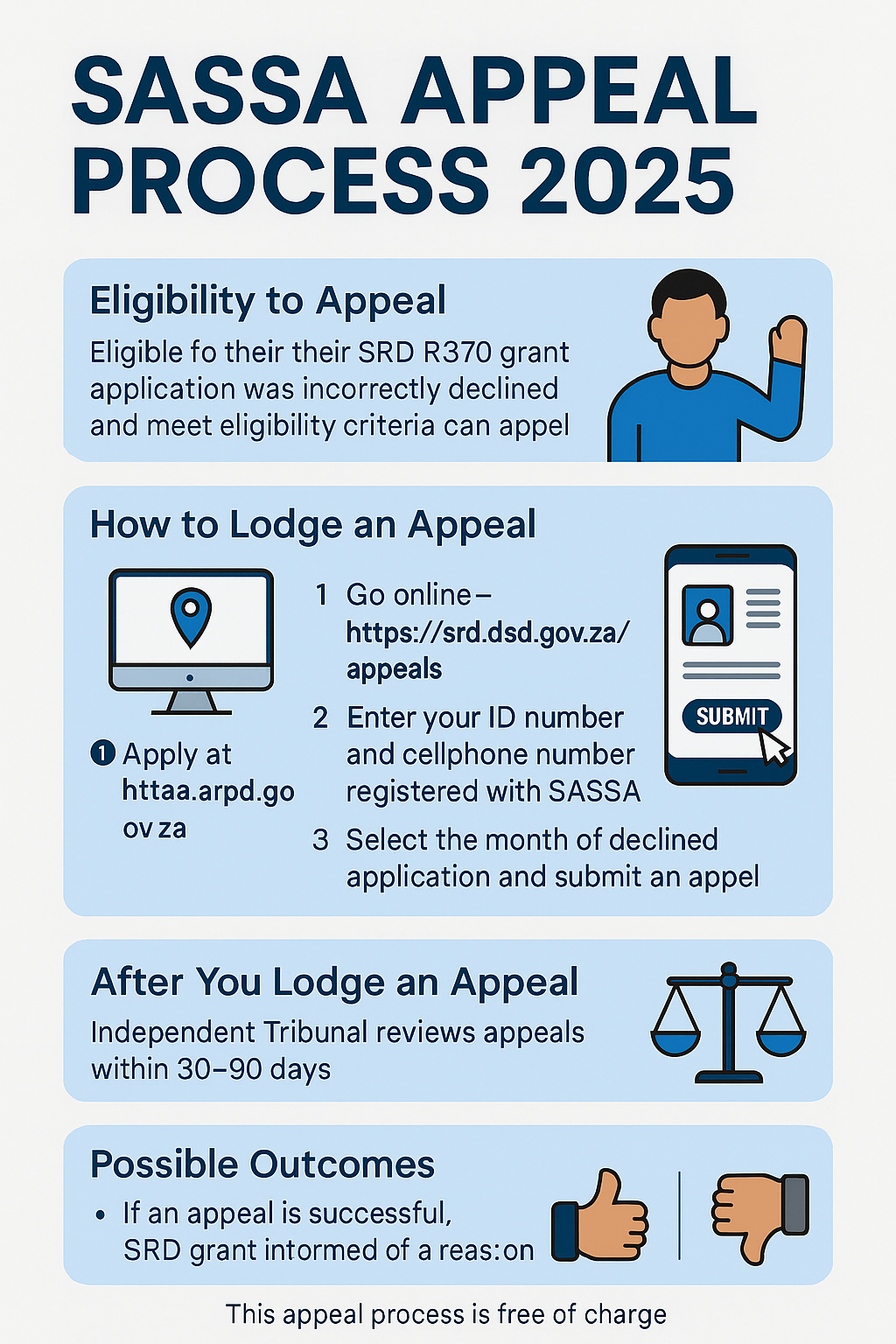
Why the SASSA Appeal Process Matters in 2025
The SRD grant, now R370 per month, was designed as temporary relief but has become a lifeline for millions. In today’s South Africa, where unemployment and rising costs continue to push families into hardship, every approved grant matters.
Yet the system isn’t perfect. Many applications are rejected because of:
- outdated government records,
- mismatched ID or bank details,
- or income flagged incorrectly.
This is where the Independent Tribunal for Social Assistance Appeals (ITSAA) steps in. It acts as a watchdog — making sure that mistakes, false flags, or outdated data don’t rob you of the support you deserve.
For many people, this appeal process has been the difference between hopelessness and relief.
What Exactly Is the SASSA Appeal Process?
Think of it as asking for a second opinion. Instead of SASSA reviewing your case again, your application is sent to the ITSAA, which operates independently under the Department of Social Development. This ensures a fairer review.
When you appeal, you’re essentially saying:
“I believe my application was declined unfairly. Here’s my situation. Please reconsider.”
And because it’s handled by an independent tribunal, it means SASSA’s own decision isn’t the final say.
Why Applications Are Declined: Stories Behind the Status
Understanding why your application was declined is the first step toward a successful appeal. Let’s look at some of the most common reasons.
- Identity Verification Failed: Your ID doesn’t match Home Affairs records. Sometimes a single letter in your surname can cause rejection.
- Means Income Source Identified: The system picked up money in your bank account above the threshold of R624/month. In reality, many applicants were flagged because of once-off deposits (e.g., a family member helping them for a single month).
- UIF Registered: Some applicants are still listed on UIF databases even though they’re no longer receiving payments.
- NSFAS Registered: Students already receiving NSFAS funding cannot qualify.
- Referred SAFPS: Your ID may be linked to fraud alerts.
Real Example: Thandi, a 34-year-old mother from Gauteng, was declined because the system detected a deposit of R650 into her bank account. It was a once-off gift from her sister, not regular income. After submitting an affidavit and bank statements, her appeal was approved.
This shows how simple mistakes or technical mismatches can unfairly exclude deserving people.
Before You Appeal: A Quick Readiness Checklist
Before submitting an appeal, ask yourself these questions:
- Was my SRD R370 application officially declined?
- Am I within the 90-day appeal period?
- Do I still have access to the same phone number I used when applying?
- Do I have documents that can support my case (like bank statements or affidavits)?
If you answered yes to all, you’re ready to lodge your appeal.
Documents That Strengthen Your Appeal
While documents aren’t always required, they can make or break your appeal. Providing proof helps the tribunal see the reality of your situation.
Examples include:
- Bank Statements (showing no income or small deposits).
- Sworn Affidavit explaining your circumstances.
- Termination Letter if you recently lost a job.
- Home Affairs Records if your ID had errors.
- Medical Reports if disability is relevant.
Tip: Always upload documents in PDF, JPG, or PNG format, under 2MB, to avoid rejection by the portal.
Step-by-Step: How to Submit a SASSA Appeal in 2025
Now let’s walk through the process. Don’t worry — it’s simpler than it looks once you know the steps.
- Go to the Appeal Portal
👉 Visit https://srd.dsd.gov.za/appeals - Enter Your ID and Mobile Number
Use the same number linked to your original application. - Get Your OTP (One-Time PIN)
You’ll receive it via SMS. Enter it on the site. - Select the Declined Month
Remember: you must appeal for each month separately. - Choose the Reason for Appeal
Pick from the drop-down list (e.g., UIF Registered, Means Income). - Upload Supporting Documents (Optional but Recommended)
Attach affidavits, bank statements, or termination letters. - Submit & Save Confirmation
Take a screenshot or note your reference number.
Pro Tip: Always keep copies — if your case is delayed, these act as proof.
How Long Does It Take? Appeal Timeline Explained
The waiting can be frustrating, but here’s what usually happens:
Stage | Timeframe |
|---|---|
Submission | Day 1 |
Initial Checks | Week 1–2 |
Tribunal Review | Week 3–6 |
Decision | Week 6–9 |
On average, expect 30 to 90 days. If it’s been longer than that, you should follow up with SASSA or ITSAA.
What If You Miss the 90-Day Deadline?
Missed the deadline? Don’t panic. You can still apply for what’s called condonation of late appeal.
This means explaining why you were late — for example, you were hospitalized, your phone was stolen, or you faced network problems. If the tribunal accepts your reason, your case will still be reviewed.
How to Check Your Appeal Status
Once you’ve appealed, the next step is tracking progress. Here’s how:
- Online Portal: Visit the appeals website, log in, and click “Check Appeal Status.”
- Call SASSA: Dial 0800 60 10 11 for updates.
- Email ITSAA: Write to grantappeals@dsd.gov.za with your ID and details.
- In Person: Visit your local SASSA office with your ID for a printout.
Statuses you may see:
- Pending: Appeal received, not yet reviewed.
- Under Review: Tribunal is checking your documents.
- Approved: Appeal successful — payment coming.
- Declined: Appeal unsuccessful (reason provided).
What If Your Appeal Is Declined? Your Next Options
If your appeal is declined, don’t lose hope — you still have two options.
- Judicial Review in High Court
This is a legal process where a court reviews whether ITSAA acted fairly. It’s complex, requires legal help, and must be filed within 180 days. - Reapply for Future Months
If your circumstances have changed (e.g., lost income, corrected ID, updated bank info), you can submit a new application. Many applicants succeed this way.
Example: Johan’s appeal was declined because of UIF records, but when he reapplied three months later, the system had updated. His grant was approved.
Common Mistakes That Cause Appeal Failures
Many appeals fail not because applicants are ineligible, but because of avoidable mistakes.
- Submitting after 90 days.
- Using a different phone number.
- Uploading blurry or irrelevant documents.
- Not checking SMS or email updates.
Being careful with these details can dramatically improve your chances.
Final Checklist Before You Submit Your Appeal
- Appeal within 90 days.
- Use the same phone number.
- Upload clear supporting documents.
- Keep proof of submission.
- Follow up after 60 days if no update.
Conclusion: Your Second Chance at Relief
A rejection doesn’t mean you’ve failed — it simply means the system needs more information. The SASSA appeal process in 2025 is there to protect you, to make sure that genuine applicants aren’t left out because of errors or technicalities.
So if you’ve been declined, don’t give up. Appeal promptly, provide proof, track your status, and follow up. For many South Africans, persistence has turned a rejection into much-needed relief.