
SASSA Disability Grant 2026: Full Guide to Eligibility, Application, Payments & Appeals
If you’re living with a disability and can’t work, the SASSA Disability Grant can be the difference between coping and falling behind on essentials like food, transport and medication.
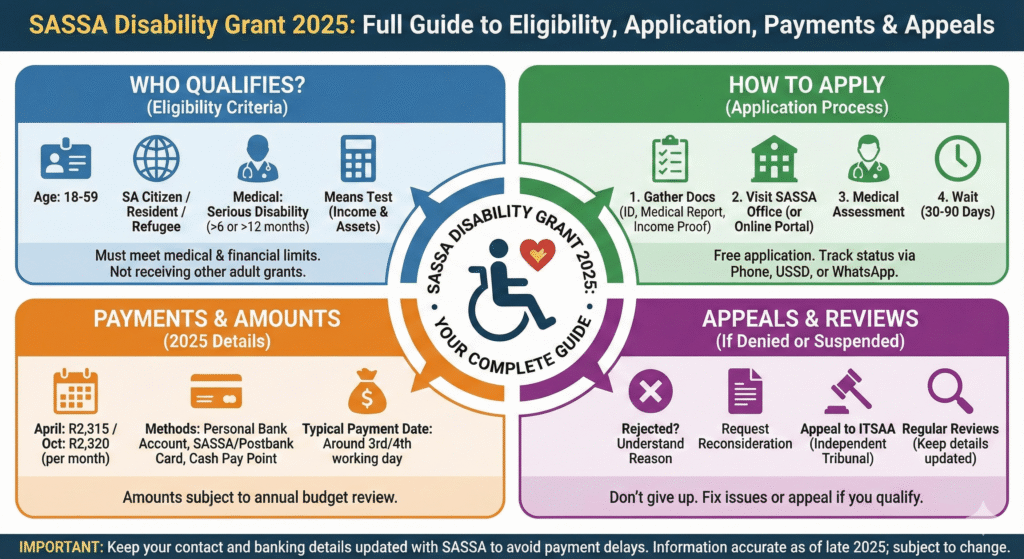
What Is the SASSA Disability Grant in 2026?
The SASSA Disability Grant is a monthly cash grant paid to adults who:
- Have a serious physical or mental disability, and
- Are unable to support themselves through work, and
- Meet the means test and other legal requirements
It is meant to cover basic living expenses – not luxury – but for many people it is the main or only income in the household.
Latest grant amount for 2026
From 1 April 2025, the disability grant increased, and from 1 October 2025, there was a small extra top-up:
- From April 2025: R2,315 per month
- From October 2025: R2,320 per month (current maximum as of late 2025)
Government normally reviews grant amounts in the national budget each year, so amounts can change again in future.
Types of SASSA Disability Grants
SASSA pays disability grants in two forms, depending on how long your disability is expected to last:
Permanent Disability Grant
“Permanent” does not mean “for life”. It means:
- Your disability is expected to last longer than 12 months
- You are unlikely to return to work soon
SASSA can still review your grant regularly to check if you still qualify.
Temporary Disability Grant
This is for disabilities that are expected to last between 6 and 12 months, for example:
- Recovering from a serious accident
- A medical condition that might improve after treatment
The grant is approved for a fixed period, after which:
- It stops automatically, or
- You may need a new medical assessment if the disability continues.
Who Qualifies? Eligibility Criteria for 2026
To receive the SASSA Disability Grant in 2026, you must meet all of these requirements.
Age
- You must be 18 years or older and younger than 60.
If you are under 18 and have a serious disability, your caregiver should apply for a Care Dependency Grant, not a disability grant.
Citizenship or Legal Residency
You must be:
- A South African citizen, or
- A permanent resident, or
- A recognised refugee
and you must live in South Africa. You will need documents such as:
- Green ID book, Smart ID card, or temporary ID
- Refugee status permit or proof of permanent residence (if applicable)
Medical Criteria
This is one of the most important parts.
- You must have a physical or mental disability serious enough that you cannot support yourself through work.
- The disability must last at least 6 months (for a temporary grant) or be expected to last more than 12 months (for a permanent grant).
You will need:
- A medical examination by a doctor appointed or recognised by SASSA
- A medical report and often a functional assessment report
The medical report:
- Must be completed on official SASSA forms
- Must usually be no older than 3 months at the time of application
Important:
The doctor’s role is to describe how your condition affects your ability to work. It’s not just the diagnosis, but how it limits you in daily life and job tasks that matters.
Means Test (Income and Assets) – 2025 Limits
The disability grant is means-tested. SASSA checks if your income and assets are below certain limits.
As of 1 April 2025, the means test for the Disability Grant is:
Assets (what you own):
- Single person: up to R1,524,600
- Married couple (combined): up to R3,049,200
Annual income (before tax):
- Single person: up to R107,880 per year
- That’s about R8,990 per month.
- Married couple (combined): up to R215,760 per year
- That’s about R17,980 per month.
If your or your spouse’s income or assets go above these limits, you may not qualify, or SASSA can reduce, suspend, or recover the grant.
These thresholds can change with new budgets, so always check the latest figures when you apply or during a review.
Not Receiving Another Adult Social Grant
You cannot receive the Disability Grant if you already receive another adult SASSA grant such as:
- Old Age Grant
- War Veterans Grant
- Another Disability Grant in your own name
(You can, however, receive child-related grants like Child Support or Foster Care for children in your care.)
Not Fully Maintained in a State Institution
If you are staying in a state institution (e.g. government hospital, rehabilitation centre, or state home) and government pays for all your needs, your grant may be reduced or stopped while you are there.
If you are in partial care (for example, an NGO facility where you still pay or contribute), SASSA may still pay the grant but can adjust how much you get.
Documents You Need for a Disability Grant Application
Having complete documents speeds up your application and helps avoid rejection for “incomplete information”.
You will usually need:
- Identity document
- South African ID book or Smart ID; or
- Valid refugee status document; or
- Temporary ID with proof that you have applied for a permanent ID
- Medical report and assessment
- Completed on SASSA’s official medical forms
- Completed by a registered medical practitioner
- Not older than 3 months when you apply
- Proof of income (for you and your spouse, if applicable)
- Recent payslips
- Pension or UIF slips
- Bank statements (usually last 3 months)
- Proof of assets
- Documents for property, vehicles, investments, shares, etc.
- Proof of residence
- Utility bill, rates bill, or letter from local authority or traditional leader
- Marital status documents
- Marriage certificate, divorce order, or spouse’s death certificate
- Bank details
- Stamped bank statement or bank confirmation letter showing your name and account number, if you want payment into your personal account
If you don’t have one of these documents (for example, you lost your ID), SASSA can sometimes accept an affidavit and alternative proof while you fix your documents, but this can delay the process.
How to Apply for the SASSA Disability Grant
You can apply in person at a SASSA office, and in some areas you may also have an online option via the SASSA services portal introduced for 2026.
Applying in Person at a SASSA Office
Step 1 – Go to your nearest SASSA office
- You must normally apply at a local SASSA office near where you live.
- If you cannot travel because of your disability, you can:
- Authorise a procurator or trusted person to apply on your behalf, or
- Request a home visit from SASSA in special cases.
Step 2 – Complete the application form
- Ask for the Disability Grant application form.
- You must complete it in the presence of a SASSA official – they will help if you cannot read or write.
- Do not pay anyone to help you; SASSA applications are free.
Step 3 – Submit your documents
Hand in:
- ID / refugee permit
- Medical report and assessment
- Proof of income and assets
- Proof of residence
- Marital status documents
- Bank details (if paying into your account)
Step 4 – Medical assessment
- SASSA may send you to a state-appointed doctor if you haven’t already been assessed on their official forms.
- The doctor will:
- Examine you
- Consider your history and existing reports
- Indicate whether your disability is temporary or permanent and how it affects your ability to work
Step 5 – Application capture and waiting period
- Once everything is submitted, SASSA captures your application.
- They should give you a receipt or reference number – keep it safe.
- Processing usually takes 30–90 days, depending on workload and completeness of your documents.
You will be notified of the outcome by SMS, letter or both.
Applying Online (Where Available)
From 2026, SASSA has been expanding online applications for certain grants, including disability, via its services portal.
Typical steps (these may differ slightly by region):
- Register for an account on the SASSA online services portal.
- Log in and select “Disability Grant”.
- Capture your personal details, income details and bank details.
- Upload clear scans/photos of supporting documents.
- Book or confirm your medical assessment as instructed.
Online application does not remove the need for a proper medical assessment and, in some cases, an in-person visit.
How to Check Your SASSA Disability Grant Status
After applying, you don’t have to sit in the dark. You can track your application in different ways:
Call Centre
- Phone the SASSA toll-free number and provide your ID and reference number.
- They can tell you whether your application is pending, approved or rejected and what the next step is.
USSD Codes (Balance & Status)
Many beneficiaries use USSD codes from their cellphones to check balances and, in some cases, SRD status:
- Dial *120*3210#
- Or dial *120*69277#
Follow the on-screen prompts and enter your:
- ID number
- Cellphone number used for your grant
Note: These codes are often promoted for SRD and balance checks and may change over time. If they don’t work, contact SASSA or your card provider for updated instructions.
- Save the official SASSA WhatsApp number (the same number used for SRD).
- Send a greeting or the keyword they provide (for example “Status”).
- Follow the prompts to check your grant status or balance.
In Person
You can also visit a SASSA office with your ID and ask them to check your status on their system – useful if:
- Your phone number has changed
- Messages have not been coming through
- You suspect a problem with your application or review
Payment Amounts and Dates for the Disability Grant
How much do you get in 2026?
As of late 2025:
- From April 2025: Disability Grant = R2,315 per month
- From October 2025: Disability Grant = R2,320 per month
Future budgets can change these amounts, usually announced around February/March each year.
When are Disability Grants Paid Each Month?
The payment pattern is usually:
- Older Persons Grants – first
- Disability Grants – the next working day
- Child-related Grants – the day after that
For example, in many 2025 months, disability grants were paid on the second grant payment day of the cycle, often around the 3rd or 4th working day of the month.
Remember:
Once your money is paid into your account or card, it stays there – you don’t have to withdraw it all on the first day.
How You Receive Your Disability Grant
You can choose the payment method that suits you best.
Payment into Your Own Bank Account
SASSA can pay your grant directly into your personal bank account if:
- The account is in your name, and
- You provide a stamped bank statement or bank confirmation letter.
This method is:
- Usually safer
- Often more convenient (no long queues)
- Good for people who already use banking apps or ATM withdrawals
SASSA/Postbank Card (Gold or Black Card)
If you don’t have a bank account, SASSA can pay your grant into a SASSA/Postbank card. With this card you can:
- Withdraw cash at ATMs
- Withdraw or pay at till points in many supermarkets
- Check your balance via USSD, ATMs or slips
Keep your card and PIN safe and never share your PIN with anyone.
Cash Pay Points
In some areas, especially rural communities, you may receive your grant at:
- Cash pay points,
- Community halls or other designated spots.
You’ll need your ID and/or grant card, and you may have to queue on payment days.
If Your Disability Grant Application Is Denied
A rejection is frustrating, but it does not have to be the end of the road.
Understand Why You Were Rejected
SASSA should give you a written reason. Common reasons include:
- Means test: your income or assets are too high
- Medical: SASSA’s doctor says your condition does not meet the disability criteria
- Documents: missing or outdated documents
- Legal status: not meeting citizenship/residency rules
Read the reason carefully – it tells you what to fix.
Correct the Problem and Reapply
Examples:
- If the medical report was too old, get a new assessment.
- If income information was incomplete, submit full and accurate proof.
- If you did not include all supporting documents, gather them and reapply.
Request a Reconsideration
If you believe SASSA made a mistake:
- You can request a reconsideration at SASSA.
- Provide any new evidence you have (updated medical reports, income proofs).
Appeal to the Independent Tribunal (ITSAA)
If your grant is still denied after reconsideration, you can lodge an appeal with the Independent Tribunal for Social Assistance Appeals (ITSAA).
- There is usually a limited time frame to appeal after receiving the rejection.
- The Tribunal looks at your case independently from SASSA.
Getting Help
If you struggle with the process, you can seek assistance from:
- Legal Aid offices
- Community advice offices
- NGOs that specialise in social grants or disability rights
They can help you understand your rights, complete forms and prepare for appeals.
Reviews, Suspensions and Overpayments
Getting a grant is not always the final step – SASSA regularly reviews beneficiaries to check they still qualify.
Why SASSA Reviews Grants
SASSA has confirmed that it is reviewing some grants to:
- Check if beneficiaries still meet the means test
- Confirm people are still alive and living in South Africa
- Ensure people have not started earning incomes far above the threshold
You might be asked to bring:
- ID
- Proof of income (or proof you are no longer employed)
- Bank statements
- Medical report (for disability)
Your Responsibilities
You must inform SASSA if:
- You start working or your income increases
- Your marital status changes
- You move to a new address
- You are admitted to or leave a state institution
If you don’t, SASSA can:
- Suspend your grant
- Ask you to repay money if you were overpaid due to undisclosed income or changes.
What If Your Grant Is Suspended?
Reasons for suspension can include:
- Not responding to review requests
- Income/assets now above the means test
- Fraud or misrepresentation
- Medical review saying you no longer qualify
If your grant is suspended:
- Read the letter/SMS or ask at a SASSA office why.
- Provide any requested documents as soon as possible.
- If you believe the suspension is wrong, follow the same steps as for appeals.
Frequently Asked Questions
Final Thoughts
The SASSA Disability Grant is a crucial lifeline for many people who can’t work because of serious health conditions. Your best chance of a smooth approval is to:
- Make sure you genuinely meet the medical and means test criteria
- Gather all required documents before you apply
- Be honest about your income and circumstances
- Keep your contact details and bank details updated
- Respond quickly to any SASSA review notices
If your application is rejected, don’t give up immediately. Understand the reason, fix what you can, and make use of reconsideration and appeals if you truly qualify.